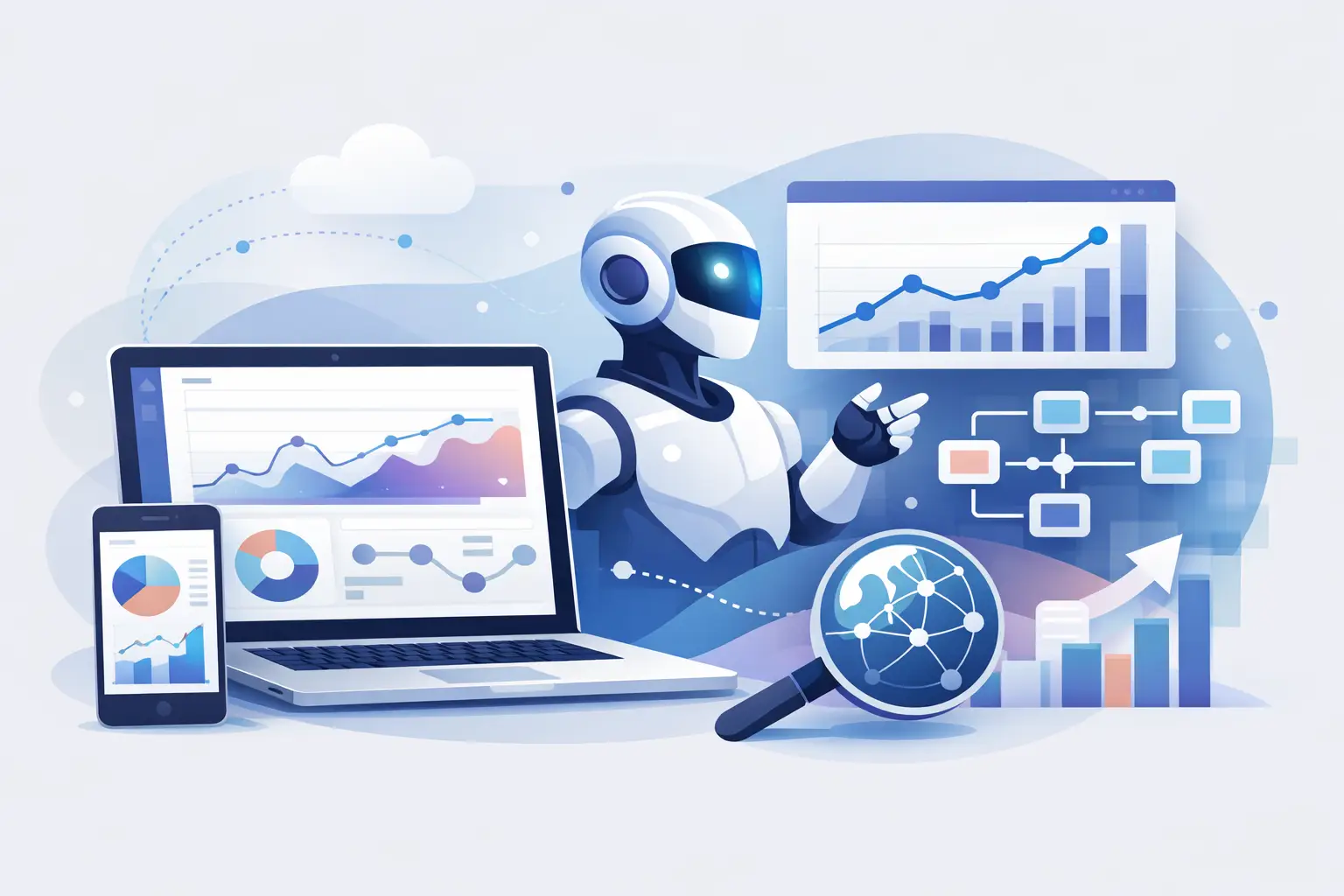
A spike in clicks used to mean one thing - people were paying attention. That assumption is getting expensive. More visits now come from AI agents, preview crawlers, assistant-driven fetches, and automated workflows that touch your links before any human ever lands on the page. If you still treat all clicks the same, your reporting is already off. That is exactly why ai agent traffic analytics matters.
For marketers, developers, and growth teams, the problem is not just bot traffic in the old sense. It is intent. Some non-human traffic is useless noise. Some of it is valuable discovery. Some of it is a buying signal because an assistant, browser tool, or workflow system is checking your content on behalf of a real person. The hard part is telling those apart fast enough to make better decisions.
What ai agent traffic analytics actually measures
Standard link analytics were built for a simpler web. You shortened a URL, shared it, and counted clicks by source, device, country, and time. That still matters, but it no longer explains the full path from link share to user action.
AI agent traffic analytics adds another layer. It looks at whether a request appears to come from an automated agent, what kind of agent it is, how it behaves, and whether that traffic should be filtered, tracked separately, or treated as part of a meaningful conversion path. In practice, that can include assistant fetchers, content preview bots, retrieval systems, browser-side automation, workflow tools, and other machine-driven requests.
This is not just a labeling exercise. When agent traffic is mixed into human traffic, campaign performance gets distorted. A link can look more popular than it really is. Device data can skew. Geographic reporting can become less useful. Routing decisions can fire based on machine activity instead of customer behavior. Attribution gets messy fast.
Why old click reports break down
Most teams notice the problem only after reporting starts to feel inconsistent. A social post gets strong click volume, but downstream conversions stay flat. A product launch link shows broad global activity, yet demand does not match the traffic pattern. A QR campaign looks like it overperformed on desktop because multiple systems fetched the destination after a mobile scan.
These are not edge cases anymore. They are normal conditions on a web shaped by automation.
The issue is not that every automated request is bad. The issue is that simple click counts were never designed to separate machine assistance from human intent. If your analytics stack cannot classify or isolate this traffic, your team ends up making real budget decisions from blended data.
That is where more precise link-layer analytics starts to pay off. Before traffic even reaches your site analytics, your link data can tell you whether a request deserves to be counted, segmented, blocked, or simply understood in context.
The business value of ai agent traffic analytics
For a growth team, better classification means cleaner attribution. You can stop treating every click as equal and start asking better questions. Did this campaign create actual user interest, or did it trigger a wave of automated previews? Did an AI workflow touch the link because it was being referenced, summarized, or passed into a tool chain? Did a human follow after that machine interaction, or did the event stop there?
For developers, the value is operational. Agent-aware analytics can support routing logic, API workflows, fraud reduction, and more reliable event handling. If a request comes from a known automated pattern, you may want one treatment. If it comes from a human using a mobile device in a high-intent market, you may want another.
For creators and startups, the biggest win is efficiency. You do not need enterprise overhead just to understand whether your traffic is real, useful, or risky. You need analytics that reflect how links are actually consumed now, without forcing you to pay premium-tool prices for basic visibility.
What good agent-aware analytics should show you
The first requirement is classification that goes beyond generic bot filtering. Basic bot detection is helpful, but it often collapses very different traffic types into one bucket. That hides useful signals.
A better system identifies patterns at link creation and at click time. It helps you understand whether traffic is likely human, automated, suspicious, or tied to a known class of agent behavior. Ideally, this sits alongside the metrics teams already depend on - referrer, device, location, timestamp, campaign tags, and destination performance.
The second requirement is context. If an AI agent hits a link, that event should not just appear as another click in a dashboard. It should be traceable enough to influence reporting and action. Maybe you exclude it from top-line campaign counts. Maybe you separate it into its own stream. Maybe you monitor it because repeated agent activity suggests your content is being surfaced more widely.
The third requirement is safety. Not all automation is benign, and not all destinations are safe. Link analytics becomes more useful when paired with trust scoring and pre-distribution scanning. That way, teams are not just measuring traffic after the fact. They are reducing avoidable risk before the link spreads.
Where teams get this wrong
One common mistake is over-filtering. Some teams see non-human traffic and decide to block or ignore it all. That keeps reports cleaner in a narrow sense, but it can erase useful signals. If an assistant or system previews a page before a user visits, that interaction may still matter. It can reflect channel behavior, content distribution, or product usage patterns worth tracking.
Another mistake is under-filtering. This is even more common because it is easier. Teams leave analytics untouched, assume inflated click totals are good news, and build campaign reporting on numbers that do not reflect audience response.
The right answer depends on the use case. A paid acquisition team may want strict human-only reporting for performance analysis. A product team may care about every machine and human request because both affect workflow reliability. A content team may want to track agent fetches as an early signal of distribution. Good analytics supports all three without forcing one default view.
Why link-level visibility matters more than ever
Site analytics tells you what happened after arrival. Link analytics tells you what happened before it. That difference matters when traffic is being shaped by AI systems, messaging apps, social previews, browser tools, and automated integrations.
At the link layer, you can see patterns earlier. You can identify traffic quality before a page view becomes a misleading success metric. You can route by device or geography with fewer false signals. You can organize campaigns around cleaner inputs.
This is also where modern link platforms have an edge over generic shorteners. A basic short link is just a redirect. A serious platform turns that redirect into a control point for analytics, safety, branding, and automation. For teams managing campaigns across channels, that control point is where wasted spend gets reduced.
AWSYS takes this seriously with AgentLink analytics built to surface AI-agent traffic in a way standard shorteners often miss, while also pairing advanced reporting with trust scoring and malicious destination blocking. That combination matters because measurement without safety is incomplete, and safety without usable analytics still leaves growth teams guessing.
How to use ai agent traffic analytics in real workflows
Start by separating reporting views. Keep one view for total activity and another for likely human traffic. This gives marketing a clean performance picture without throwing away operational context.
Next, compare link clicks against downstream events. If link traffic rises while engaged visits or conversions do not, inspect the share of agent activity before changing creative or budget. The problem may be traffic composition, not campaign quality.
Then look at distribution channels. Some channels naturally trigger more automated fetches than others. That does not mean those channels are weak. It means they need adjusted expectations and cleaner baselines.
Finally, connect analytics to action. If suspicious patterns rise, tighten link controls. If agent traffic reveals useful discovery behavior, keep tracking it separately. If certain campaigns attract clean, high-intent human traffic, scale those first.
The teams that win here are not the ones with the biggest dashboards. They are the ones using better traffic classification to make fewer bad decisions. As AI agents become a normal part of how links are accessed, shared, and evaluated, the question is no longer whether your traffic includes them. It is whether your analytics can tell you what that traffic means before you spend more money on the wrong story.
Start there, and your links become more than redirects. They become a clearer source of truth. #AWSYSCO