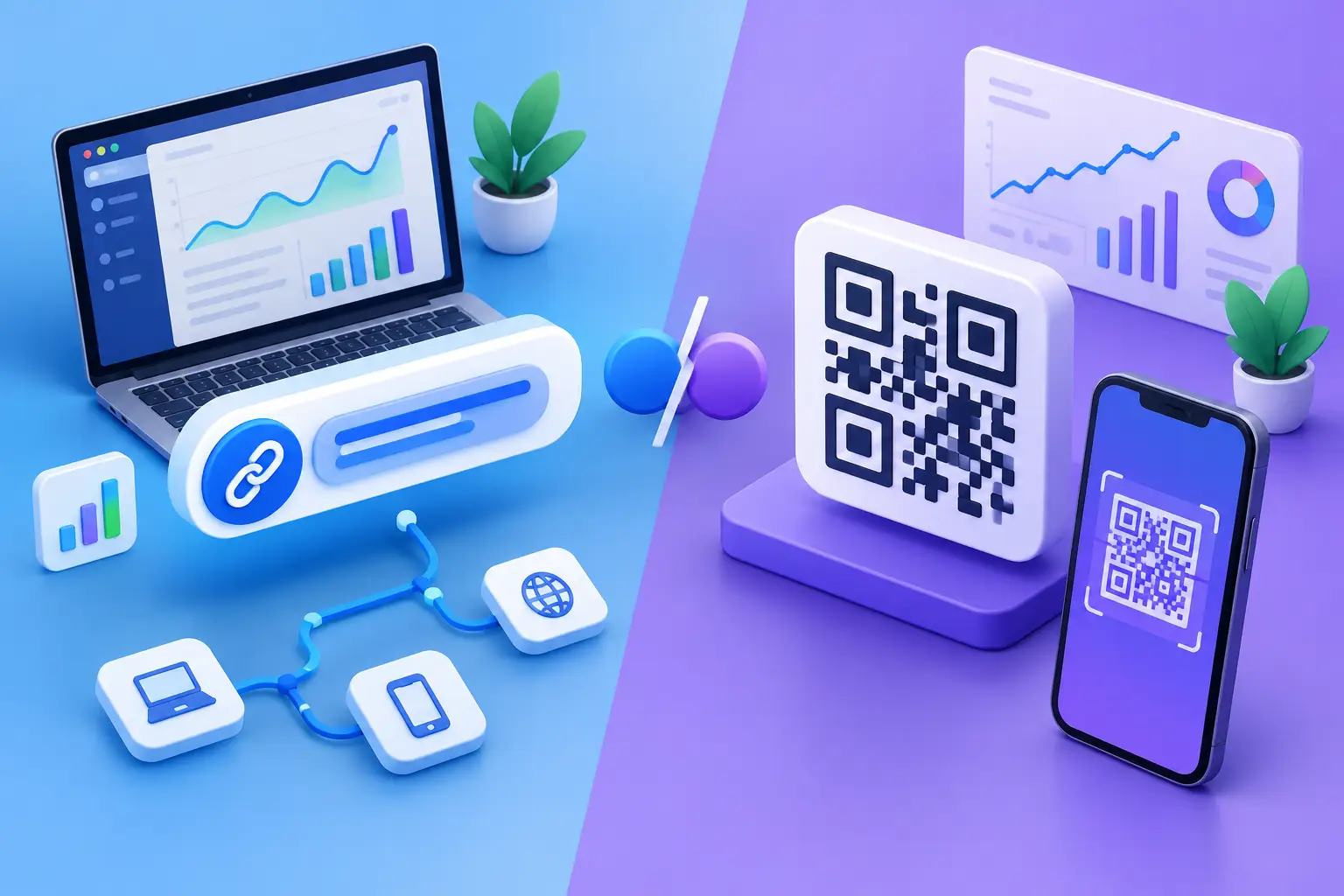
A customer is standing in front of your product display, event banner, or direct-mail piece. They have two seconds to decide whether scanning is worth the effort. Later, that same customer sees your campaign in an email or social post, where a clickable link is the obvious path. That is the real decision behind branded URLs vs QR codes: not which tool wins, but which action fits the moment.
For growth teams, creators, and developers, treating them as interchangeable leaves performance on the table. A branded URL builds recognition and works anywhere people can click, copy, or type. A QR code removes typing from offline and cross-device experiences. Used together, they connect physical attention to measurable digital action.
Branded URLs vs QR Codes: The Core Difference
A branded URL is a short, custom link that uses a domain you control, such as `go.yourbrand.com/spring`. It takes people to a destination while giving you control over the link name, routing, and measurement. Because the domain and slug are visible, the link can reinforce what users are about to see before they click.
A QR code is a machine-readable visual pattern. A phone camera scans it and opens the encoded destination, usually a URL. It is not a replacement for the link itself. In most useful campaigns, the QR code contains a branded short URL.
That relationship matters. The QR code is the entry point; the URL is the destination layer that handles trust, routing, tracking, and future changes. If you print a QR code that points directly to a long destination URL, you lose much of the flexibility that makes QR campaigns useful in the first place.
Choose Based on Where the Audience Meets You
Branded URLs are strongest in digital environments. Use them in email campaigns, social captions, paid ads, SMS, creator partnerships, chat, documentation, and product notifications. A reader can click instantly, and a concise branded link is easier to recognize, share, and remember than a long string of parameters.
They also work well when the link needs to be spoken, displayed on screen, or manually entered. A URL such as `go.brand.com/demo` gives the audience a clear destination and gives your team a campaign asset that can be organized and reused.
QR codes are strongest when typing would create friction. Think packaging, retail displays, restaurant tables, conference badges, printed flyers, postcards, trade-show booths, presentation slides, and out-of-home advertising. Scanning turns an offline surface into a direct path to a product page, signup form, video, app download, or limited-time offer.
The trade-off is simple: QR codes require a camera and a reason to scan. A code with no context can feel like a black box. Add a specific call to action nearby, such as “Scan for the installation guide,” “Scan to claim your sample,” or “Scan to see the full collection.” The user should know both the value and the expected destination before they point their camera.
Why Branded Links Build More Confidence
People have learned to be cautious around unfamiliar links and unexplained QR codes. A random short domain can look suspicious even when the destination is legitimate. A recognizable branded domain provides a useful signal: this link belongs to the business speaking to them.
That does not mean branding alone makes a destination safe. It means your link strategy should pair a clear domain with destination controls. Teams should be able to review where a link goes, avoid accidental redirects, and catch malicious destinations before distribution. This is especially relevant when links are created by multiple campaign owners, partners, or automated workflows.
A QR code has an extra trust challenge because the destination is hidden until after a scan. Place your branded domain in the surrounding copy whenever possible. For example, a package can show both the code and `go.yourbrand.com/setup`. Users who prefer not to scan still have a readable option, while the visible URL provides reassurance.
The Analytics Question Is Bigger Than Clicks
A basic count of scans or clicks is useful, but it rarely answers the question a marketer actually has: did this campaign create meaningful action?
Branded URLs make it easier to separate traffic by channel, placement, audience, or creative. You can create distinct links for an email footer, an influencer post, a podcast mention, and a paid social campaign, then compare performance without guessing where visitors originated. Details such as referrers, devices, geography, and time patterns can reveal why one placement outperforms another.
Dynamic QR codes extend that same control to physical media. Create a unique code for each store location, event, brochure version, or product batch. If one conference booth produces far more qualified traffic than another, you can see it. If a printed offer needs a new destination after distribution, you can update the redirect behind the code rather than reprint thousands of materials.
Keep QR and URL reporting separate when they represent different behaviors. A scan at a retail shelf is not equivalent to a click in an email. They may lead to the same landing page, but the context, intent, and conversion path are different. Give each placement its own link and label it clearly from the start.
For technical teams, this is where link management becomes more than a marketing utility. APIs, webhooks, and structured campaign naming can turn link activity into data your CRM, analytics stack, or internal reporting can use. Modern traffic also includes visits from AI assistants and automated agents. Knowing when those systems access a link helps prevent bot activity from being mistaken for human campaign engagement.
Use a Branded URL Inside Every QR Code
The practical default is not branded URL or QR code. It is a branded URL inside a dynamic QR code.
This setup gives you a visible, trustworthy address for digital sharing and a scannable shortcut for physical surfaces. It also avoids a common operational problem: a campaign team prints a code tied to a final destination, then discovers the landing page needs to change. With a managed branded link, the printed code remains valid while the routing can be updated behind it.
For a product launch, you might use `go.yourbrand.com/launch` in social posts and email, while separate QR-linked URLs identify packaging, in-store displays, and event signage. The campaign remains connected at the reporting level, but every channel retains its own attribution.
AWSYS supports this model by combining branded links, QR generation, traffic routing, analytics, and link safety controls in one workspace. The point is not to add another dashboard. It is to create, measure, and adjust campaign paths without paying premium-platform overhead for basic link control.
Avoid the Mistakes That Make Both Underperform
First, do not use one generic link for every channel. It makes attribution vague and turns useful reporting into a guess. Create distinct links for distinct placements, even if they all route to the same page.
Second, do not make people scan a QR code when a click is available. In an email, a visible button or branded URL is usually faster. In a PDF meant to be viewed on a phone, a QR code can be awkward because the user may be unable to scan their own screen. Give them a clickable option.
Third, do not print static destination URLs into permanent campaign materials unless the destination is genuinely permanent. Dynamic routing preserves flexibility. It also lets you pause a promotion, redirect a retired page, or send mobile users to a more appropriate experience.
Finally, do not treat design as decoration. QR codes need enough contrast, quiet space, and size to scan reliably. Branded customization can help them match a campaign, but excessive styling can reduce scan performance. Test with multiple phones and lighting conditions before anything goes to print.
A Better Decision Rule
Use a branded URL when your audience is already online and can click. Use a QR code when the audience is looking at something physical or moving between devices. Use both when you need one campaign to travel across digital and real-world touchpoints without losing measurement or control.
The strongest campaigns make the next action obvious, keep the destination trustworthy, and give the team enough data to improve the next placement. Start with the audience's context, build every QR code on a branded link, and let the results tell you where attention turns into action. #AWSYSCO