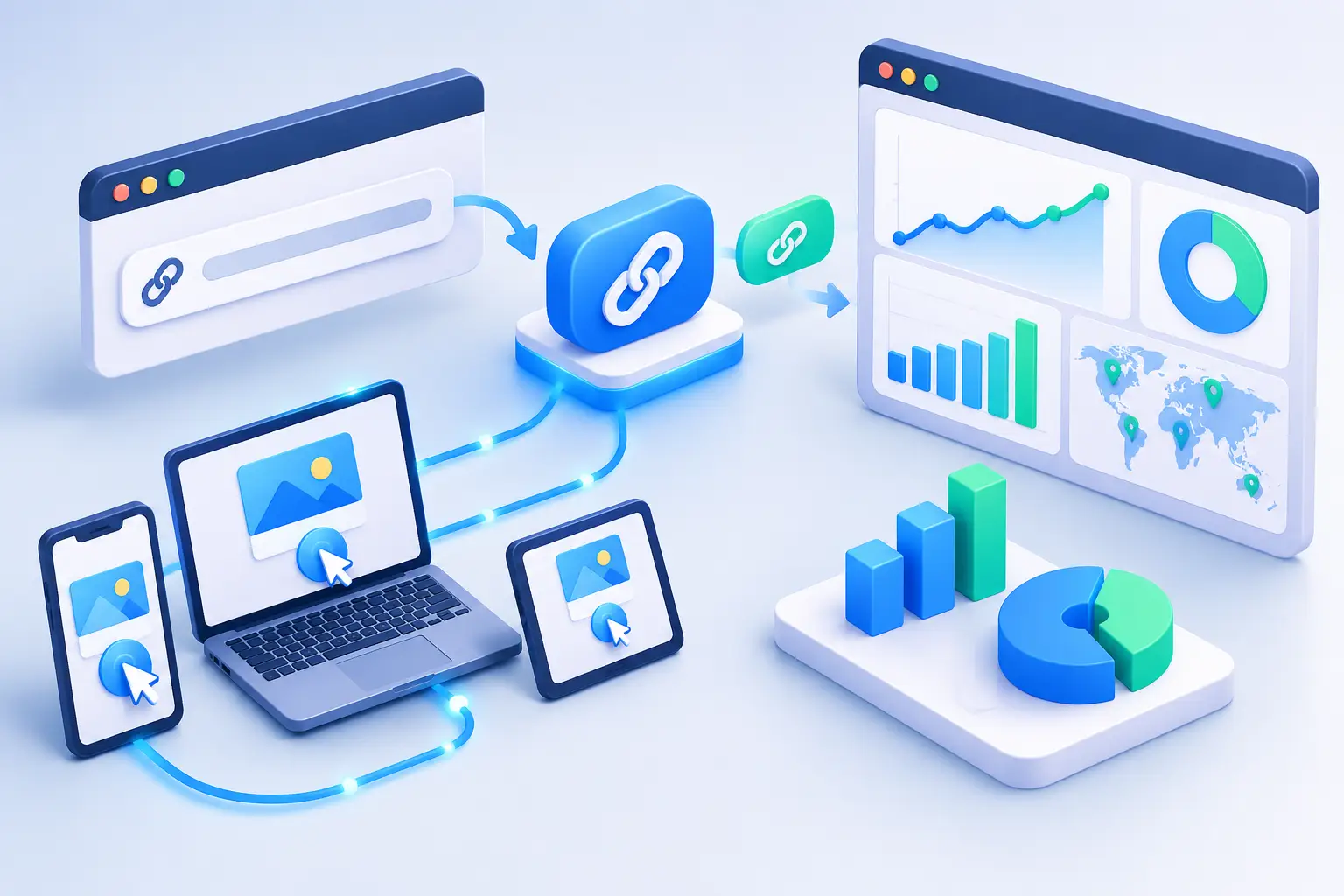
A link in a campaign email, creator bio, ad, QR code, or product workflow has one job: get someone to the right destination. But a bare, oversized URL does nothing to build trust, explain where it leads, or show what happened after the click. A URL shortener solves the first problem by making links easier to share. The right platform solves the bigger ones too: branding, attribution, traffic control, and safer distribution.
What a URL Shortener Actually Does
At its most basic, a URL shortener creates a compact redirect. Someone clicks a short link, and the service sends them to the destination URL. That is useful when character count matters, a long link looks messy, or a QR code needs to stay easy to scan.
For growth teams, however, shortening is only the visible layer. Every short link can become a controlled distribution point between an audience and a destination. Instead of publishing a long, static URL across multiple channels, you publish a branded, measurable link that can support campaign-level decisions.
That distinction matters when one landing page appears in paid social, newsletters, partner posts, printed materials, and internal documentation. If every channel uses the same raw URL, you lose context. If each channel has its own short link, you can compare performance without asking your team to rebuild the destination page.
A short link is not automatically better just because it is shorter. The value comes from what it helps you manage after it is shared.
Short Links Improve the Click Before It Happens
People decide whether to click quickly. A long URL filled with tracking parameters can look careless or suspicious, especially in a message, social post, or printed QR code. A clean link on a custom domain is easier to read, easier to remember, and more consistent with the brand behind it.
The destination should still match the promise of the link. If a social post promotes a free template, the click should lead directly to that template or its relevant sign-up page, not a generic homepage. Shortening cannot repair a weak campaign path. It can make a strong one clearer and more measurable.
Custom aliases add another layer of clarity. A link such as yourbrand.co/fall-guide tells users more than a random string of characters. It also gives marketers a practical naming system. Teams can use campaign names, content types, markets, or partner labels to make links recognizable in reports months later.
This is especially useful when links outlive a launch. A creator may keep a link in a bio for weeks. A QR code may stay on a brochure for a year. A developer may place a link inside an onboarding flow that users encounter long after the original release. Organized naming prevents those assets from becoming a mystery later.
Build Campaign Control Around Every Link
A useful link management strategy starts before publication. Create links by campaign and channel, set a clear destination, and use consistent aliases that your team can understand at a glance. Then decide what information you need to act on.
For a product launch, that may mean separate links for paid social, organic posts, email, affiliates, and event QR codes. The destination can be identical, but the traffic source should not be invisible. Separating distribution links helps reveal which effort drives attention and which one drives meaningful engagement.
Traffic routing can take this further. A visitor on a mobile device may need a different destination than someone on a desktop browser. A user in one market may need a localized page. A time-sensitive promotion may need to route to a current offer after an earlier offer ends. These controls reduce the need to replace links everywhere a campaign has already been published.
That flexibility has a trade-off: it requires discipline. If a team changes destinations without documenting the reason, analytics become harder to interpret. Give links a clear owner, use labels that reflect intent, and keep campaign changes tied to a real decision. Control is valuable when it creates clarity, not when it adds unnecessary complexity.
Security Is Part of Link Performance
A short link asks for trust because the final destination is not fully visible at a glance. That makes safety a performance issue, not merely a technical feature. Suspicious links get ignored, reported, or blocked. Legitimate campaigns can lose clicks when audiences have been conditioned to avoid unknown redirects.
A modern platform should scan destinations and block malicious ones before they spread. It should also provide a transparent trust score at the moment a link is created, giving the person publishing the link a clear signal instead of making safety an afterthought.
This matters for marketers, but it matters just as much for developers and teams building automated workflows. Links may be created at scale through an API, generated for customers, or passed between tools. Without guardrails, a high-volume workflow can distribute risk just as efficiently as it distributes content.
Safer links do not replace good judgment. Check the destination, keep access limited to the people who need it, and avoid sending users through confusing redirect chains. The goal is simple: make every click feel expected and credible.
Analytics Should Change What You Do Next
Click counts are a starting point, not a verdict. A thousand clicks can represent a breakout post, low-intent traffic, a bot-heavy source, or a QR code people scanned out of curiosity. Context makes the number useful.
Look at traffic sources, device types, geography, timing, referrers, and campaign-level performance together. A creator might find that mobile traffic from a profile link converts differently than desktop newsletter traffic. A startup team may see that a partner channel brings fewer clicks but stronger product interest. A developer may use webhook events or API data to connect link activity with internal reporting.
The best analytics answer operational questions. Which channel deserves more budget? Which placement needs a clearer call to action? Which market should receive a localized page? Which QR code is still producing traffic after an event? When reports only produce vanity metrics, they create activity without direction.
There is also a practical measurement issue: not every click represents a person. Preview tools, security scanners, browsers, and automated systems can request links. Good link analytics help distinguish the shape of traffic so your team does not mistake automated activity for audience demand.
AI Traffic Needs Its Own View
AI systems are becoming another route through which people discover products, content, and tools. That traffic does not always look like a conventional social referral or search visit. An AI agent may retrieve, inspect, or act on a link as part of a workflow, and those interactions can be easy to miss in standard reporting.
AgentLink capabilities give teams a clearer way to track AI-agent traffic alongside human clicks. For businesses testing AI-assisted support, research, content distribution, or automated operations, that visibility is becoming increasingly relevant. You cannot optimize a source you cannot see.
The key is not to treat AI-agent activity as automatically good or bad. It depends on the use case. A support workflow may benefit from agent access, while a campaign report may need to separate it from human engagement. Better classification gives you the option to make that decision.
Choosing a URL Shortener for Real Work
A free shortener can be enough for a one-off personal link. It becomes limiting when links represent brand touchpoints, paid media, product flows, or shared team assets. At that point, evaluate the platform based on the work you need it to support, not just the number of characters it removes.
Look for branded domains, custom aliases, QR code creation, detailed click analytics, routing rules, safety scanning, cross-device access, and automation through APIs or webhooks. Then consider whether those capabilities are accessible without forcing a growing team into an inflated tool stack.
AWSYS is built for that middle ground: premium-grade link intelligence and advanced controls for people who want to measure, customize, secure, and scale their links without paying extra for basic functionality. Start with the links already carrying your campaigns, then turn the data into a better next move.
A short URL may be the smallest element in a campaign, but it can hold the clearest evidence of what is working. Start shortening safely, keep every link accountable, and make the next click more useful than the last. #AWSYSCO