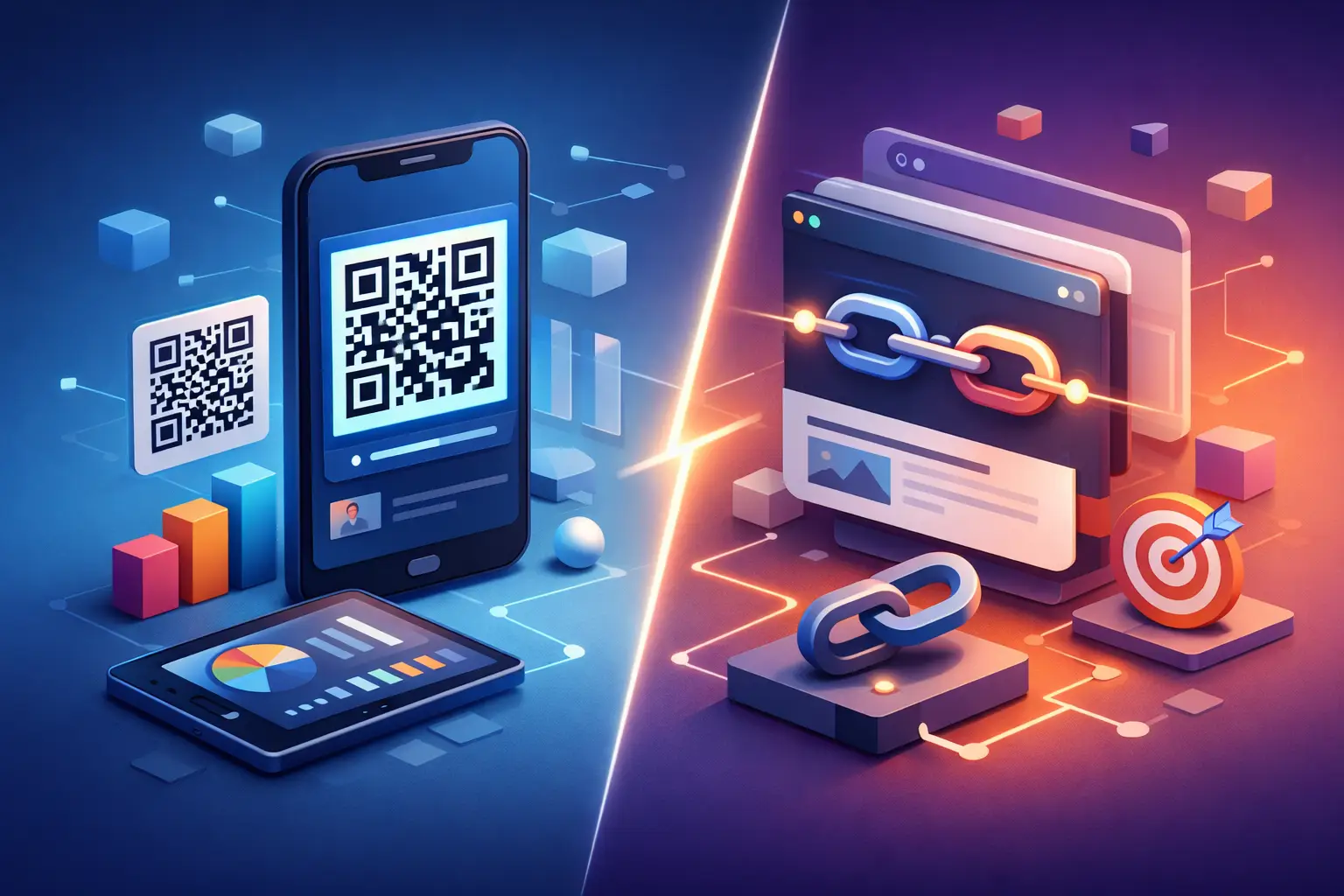
A product label has room for a square code. A social post has room for a clickable URL. Treating those two placements the same is how campaigns lose scans, clicks, and useful attribution. The real decision in qr codes vs short links is not which format is better overall. It is which format removes friction at the exact moment someone is ready to act.
Both can send people to the same destination, and both can be measurable when managed correctly. But they work in fundamentally different environments. QR codes bridge the physical world to a screen. Short links reduce friction inside digital experiences. Strong campaigns use each format for what it does best, then connect both to a controlled, trackable destination.
QR Codes vs Short Links: The Core Difference
A QR code is a visual shortcut. Someone opens their camera, scans the code, and lands on a page without manually typing a URL. Its advantage is obvious when the audience is looking at something offline: packaging, event signage, direct mail, storefront displays, presentations, print ads, or a TV screen.
A short link is a compact, clickable URL. It belongs where people can tap, copy, paste, share, or remember a link: social media captions, SMS, email, chat, creator bios, support messages, documentation, and product workflows. A branded short link also tells people where they are going before they click, which can improve recognition and confidence.
The destination may be identical, but the interaction is not. Asking someone to scan a QR code in an email they are already reading on their phone adds an unnecessary step. Posting a short link on a poster requires someone to type it, which creates an equally avoidable drop-off.
When QR Codes Win
QR codes are built for moments when a person is away from a clickable interface. A restaurant can place one on a table to open a menu. A retailer can put one beside a product display to show setup instructions, reviews, or a limited-time offer. An event team can use one to collect registrations, distribute speaker materials, or drive visitors to a follow-up page.
They also work when speed matters. A code on a conference badge or slide lets a room full of people act at once. No one has to photograph a long URL, search for it later, or ask where to find the resource.
That said, QR codes are not automatically high-converting. They need a clear reason to scan. A bare code with no context can feel suspicious or easy to ignore. Add a direct call to action near it, such as “Scan for the event schedule,” “Scan to claim your offer,” or “Scan for setup help.” The user should know what they get before they open their camera.
Design matters too. Keep enough contrast, preserve the quiet space around the code, and test it at the real viewing distance. A beautifully designed code that fails under glare, on curved packaging, or from six feet away is not a campaign asset.
When Short Links Win
Short links are the practical choice for digital distribution. They are easy to tap in a text message, fit cleanly in a social post, and are far more usable in a verbal or visual mention than a long URL full of tracking parameters.
They become more valuable when they are branded. Compare a generic-looking redirect with a concise link using a recognizable custom domain and a readable path. The second option gives the audience a signal of ownership. That matters in crowded inboxes, fast-moving social feeds, and messages where trust determines whether a click happens at all.
Short links also give teams more control over campaign organization. You can create distinct links for a newsletter, a creator partnership, a paid social variation, a sales sequence, or an in-app prompt, even when each one directs traffic to the same page. Instead of guessing which channel created demand, you can see which distribution decision performed.
For developers and product teams, short links are especially useful in automated workflows. They can be created through an API, routed by device or geography when appropriate, updated without replacing every public reference, and monitored through analytics or webhooks. That is a much better fit than generating a static destination URL and hoping it remains useful after the campaign changes.
The Tracking Question Most Teams Miss
A QR code is not analytics by itself. It is an image that contains data, usually a URL. If that encoded URL goes directly to a landing page, you may see traffic in your web analytics, but you lose the clean campaign-level control that makes QR performance easier to evaluate.
The better setup is a dynamic QR code that encodes a managed short link. This gives you the physical convenience of scanning and the digital intelligence of a redirect layer. You can measure scans, clicks, referrers when available, devices, locations, and timing. More importantly, you can change the destination later without reprinting the code.
That distinction has real budget consequences. A static QR code printed on thousands of flyers cannot be fixed if the destination changes, breaks, or becomes outdated. A dynamic code tied to a short link can point visitors to the current page while preserving the campaign history.
Use separate links for separate placements. Do not put one code on every poster, package, and handout if you need to know what is working. Create a distinct destination path for the lobby sign, the checkout counter, the event booth, and the insert card. The audience sees a simple experience, while your team gets actionable data.
Trust Is a Format Issue, Not Just a Security Issue
Both formats can create hesitation. People cannot see a QR destination until after scanning, and many short links hide the full URL by design. That means trust has to be designed into the campaign.
With QR codes, pair the code with your logo, brand colors used carefully, a clear outcome, and placement on a credible asset. A code on official packaging feels different from an unexplained sticker in a public space. With short links, use a branded domain and readable slug instead of random characters whenever possible.
Behind the scenes, destination safety matters just as much. Teams should scan destinations before distribution and avoid letting compromised or malicious URLs enter campaign workflows. AWSYS adds transparent trust scoring at link creation and automatically blocks malicious destinations, helping teams identify risk before a link reaches customers.
Trust also affects measurement. If a recipient does not recognize the link or understand the QR call to action, they will not engage. Low engagement may look like weak creative or poor targeting when the actual issue is uncertainty at the click or scan.
Choose by Context, Then Connect the Data
Use QR codes for physical surfaces and screen-to-phone handoffs. Use short links for digital channels where a tap is possible. When a campaign crosses both worlds, use both formats with separate tracking paths.
For example, a product launch might use a QR code on in-store displays, a branded short link in creator posts, and another short link in SMS reminders. All three can lead to the same launch page, but each should be identifiable in reporting. This shows whether the store display created interest, which creator drove visits, and whether the reminder converted undecided customers.
There are a few edge cases. QR codes can work in digital content when a user is viewing a desktop screen and needs to continue on mobile, such as a webinar slide or a streaming ad. Short links can work in print when they are exceptionally short, branded, and easy to type, but they are usually the backup option rather than the primary action.
Build a Better Campaign Workflow
Start with the conversion action, not the format. Decide what you want the person to do after engaging: buy, register, download, book, watch, install, or contact your team. Then identify the environment where they encounter the campaign and choose the lowest-friction path.
Create a unique managed link for each channel or placement. Add the right campaign parameters, use a clear branded slug, and confirm that the destination works on mobile before distribution. For physical placements, generate a dynamic QR code from that link and test it on multiple phones under normal lighting conditions.
After launch, watch more than raw volume. Compare engagement by channel, device mix, location, time period, and downstream conversion. If a QR code gets plenty of scans but little action, the landing page may not match the promise beside the code. If a short link has low clicks, improve its surrounding copy, placement, or trust signals before assuming the offer failed.
The best choice is often not QR code or short link. It is one trackable system that lets every customer take the easiest next step, while giving your team a clear reason to repeat what works. #AWSYSCO