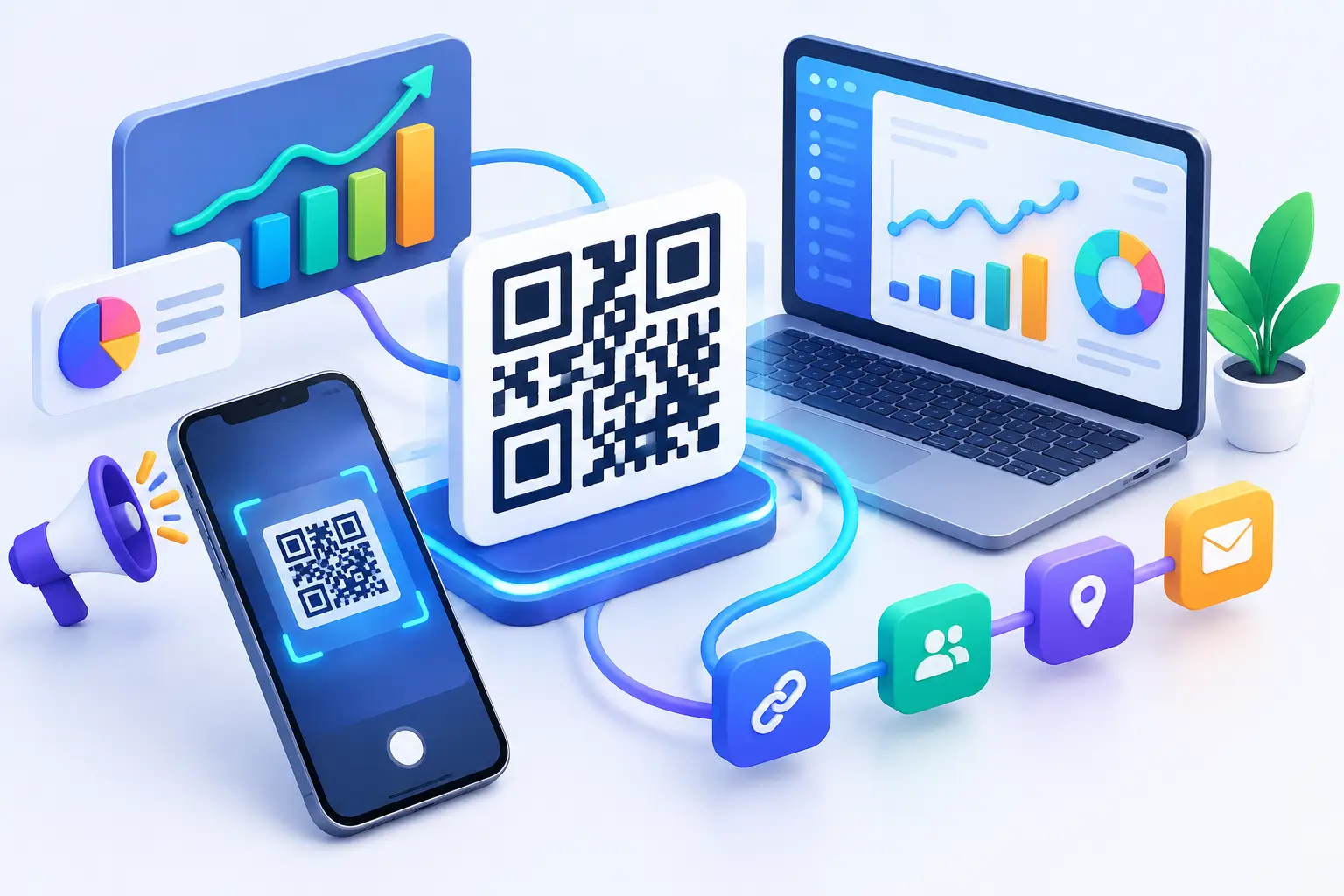
A QR code on a poster is no longer a novelty. It is a handoff point between a physical moment and a measurable digital action. That shift is driving the most useful QR marketing trends: smarter destination routing, branded experiences, stronger safety signals, and analytics that tell marketers what happened after the scan.
For growth teams, the opportunity is not simply to place more codes in more places. It is to treat every scan as a campaign interaction with context. A code on product packaging, a trade-show booth, a direct mail piece, or a creator's video can each lead somewhere different, collect different data, and serve a different next step.
QR Marketing Trends Are Becoming Measurement Trends
The biggest change in QR marketing is the move from static codes to dynamic, trackable campaign assets. A static QR code hard-codes one destination. If the landing page changes, the campaign changes, or the original URL breaks, the printed material may become useless.
A dynamic QR code points to a managed short link instead. The code can stay in market while the destination changes behind it. That flexibility matters when inventory ships before a promotion is final, when an event schedule moves, or when a campaign needs a quick correction without reprinting thousands of assets.
More importantly, dynamic codes make scans visible. Marketers can compare scan volume by code, date, device, location, and referral context where available. The question changes from “Did people see our flyer?” to “Which placement produced qualified traffic, and what did those visitors do next?”
That does not mean every QR code needs a complex reporting setup. A restaurant menu may only need a stable destination and basic scan totals. A multi-market retail launch needs separate codes by store, placement, creative version, and campaign period. The right level of tracking depends on how expensive it would be to make the wrong decision.
Branded Codes and Links Are Doing Trust Work
A QR code hides its destination until a customer scans it. That creates a trust problem, especially as people become more alert to phishing, fake parking notices, and stickers placed over legitimate signs.
Branding helps reduce that uncertainty. A code with a recognizable logo, supporting copy, and a branded short domain gives people more reason to believe the scan will lead somewhere expected. The code should never be the only instruction. Add a clear value statement nearby: “Scan for setup help,” “Get the event schedule,” or “See available colors.” Specificity beats “Scan me.”
The destination has to earn trust too. A scan that opens a slow page, an unrelated homepage, or a long form burns the goodwill created by the physical placement. Match the landing page to the promise beside the code. If the code says “Claim your sample,” the first screen should make claiming the sample obvious.
Safety is now part of campaign performance, not a back-office concern. Teams should scan and test every code before launch, review destination changes carefully, and use link tools that assess destination risk at creation. AWSYS, for example, combines branded link controls with transparent trust scoring and malicious-destination blocking, giving teams a practical safeguard before a code reaches print, packaging, or a paid placement.
Contextual Destinations Beat One-Size-Fits-All Landing Pages
A QR scan carries context that a standard web visit often does not. The customer may be standing in a store aisle, watching a presentation, holding a product, or waiting in line. Their attention is limited, and their next action should be easy on a phone.
That is why mobile-first destinations are becoming a baseline rather than a nice extra. The page should load quickly, use large tap targets, avoid unnecessary navigation, and ask for only the information required for the next step. A QR code is usually an interruption in the real world. It should not open a desktop-style research project.
Context also supports better routing. One printed code might send a visitor to a localized page based on country, a current promotion based on date, or the appropriate app store based on device. For a global campaign, this avoids cluttering the creative with multiple codes and reduces the chance that a customer lands on the wrong experience.
There is a trade-off. Highly personalized routing can make troubleshooting harder and can obscure campaign reporting if naming conventions are weak. Keep the logic understandable. Every code should have an owner, a defined purpose, and a label that explains where it appeared. “Spring_Box_Insert_A” is more useful than “QR-14.”
QR Codes Are Moving Beyond Print
Print remains powerful because QR codes make offline materials measurable. But the format is expanding into screens, video, product interfaces, and live events.
Connected TV and streaming ads are a clear example. A viewer may not remember a long URL, but they can scan a code and continue on their phone. The message needs a compelling reason to act now, because the viewer can also ignore it in seconds. A code that leads to a generic homepage wastes the moment; a code that opens a limited product collection, waitlist, or event reminder gives the scan a purpose.
Creators are using QR codes in video overlays, livestreams, and event appearances to move audiences from passive viewing to a trackable destination. Retailers are placing them on shelves and displays to bridge discovery with product details, reviews, tutorials, and availability. B2B teams are using them on booth signage and presentation slides to deliver resources without asking prospects to type a URL or wait for a follow-up email.
Placement still matters. A code in a fast-moving video must stay on screen long enough to scan. A code at a venue needs enough contrast, adequate size, and a position that does not force people to crowd into a walkway. Test it with a normal phone camera from a realistic distance, not only from a designer's screen.
First-Party Campaign Data Is More Valuable Than Raw Scan Counts
A scan is an engagement signal, not automatically a conversion. High scan volume can reflect strong creative, curiosity, or confusion. Low scan volume can reflect poor placement, a weak call to action, or an audience that simply prefers another path.
The useful measurement model connects each QR code to the next event: page view, product interaction, lead form completion, app install, coupon redemption, or purchase. Build codes around a campaign taxonomy so reports can answer practical questions. Which event sign generated the most demo requests? Which package insert drove repeat orders? Did the in-store code produce more engaged traffic than the paid social version of the same offer?
Use unique codes when the placement, creative, or audience differs materially. Reusing one code across every channel may look simpler, but it removes the evidence needed to optimize. At the same time, do not create dozens of nearly identical codes without a reporting plan. Granularity only pays off when someone can act on it.
QR measurement is also expanding to include emerging traffic sources. As AI assistants and automated agents increasingly retrieve and recommend content, growth teams need to separate human visits from agent activity where possible. This will matter most for publishers, developers, and businesses building content journeys that can be discovered through both search and AI-mediated experiences.
The Best QR Experiences Exchange Value for Attention
Customers scan because they expect a payoff. That payoff can be useful information, a faster task, an exclusive offer, a personalized experience, or entertaining content. The most effective QR campaigns make the exchange clear before the camera opens.
For example, a software team might place a code at an event that opens a concise implementation checklist rather than a broad marketing page. A consumer brand might use packaging to offer a product tutorial, replenishment option, and care instructions in one mobile-friendly flow. A creator might offer a bonus template or behind-the-scenes clip that fits the audience's reason for watching.
Avoid using QR codes as decoration. If typing a short, memorable URL is easier than scanning, or if the destination adds no value beyond what is already visible, the code is not solving a customer problem. Good QR marketing removes friction. It does not add another step simply because the technology is available.
Build a QR Program, Not a Collection of Codes
Teams that get results from QR campaigns treat codes like other performance assets. They set a goal, define the conversion event, assign a clear destination, test the physical or on-screen experience, and review the results on a regular cadence.
Start with one high-intent moment rather than covering every asset with a QR code. A package insert, event booth, product display, or customer onboarding email can reveal plenty about audience behavior when the offer and measurement are clear. Once you know what drives useful scans and downstream action, expand with confidence.
The practical advantage is simple: a QR code can turn an unmeasurable offline moment into a campaign you can improve. Give people a reason to scan, give them a destination worthy of their attention, and give your team the data to make the next placement smarter. #AWSYSCO