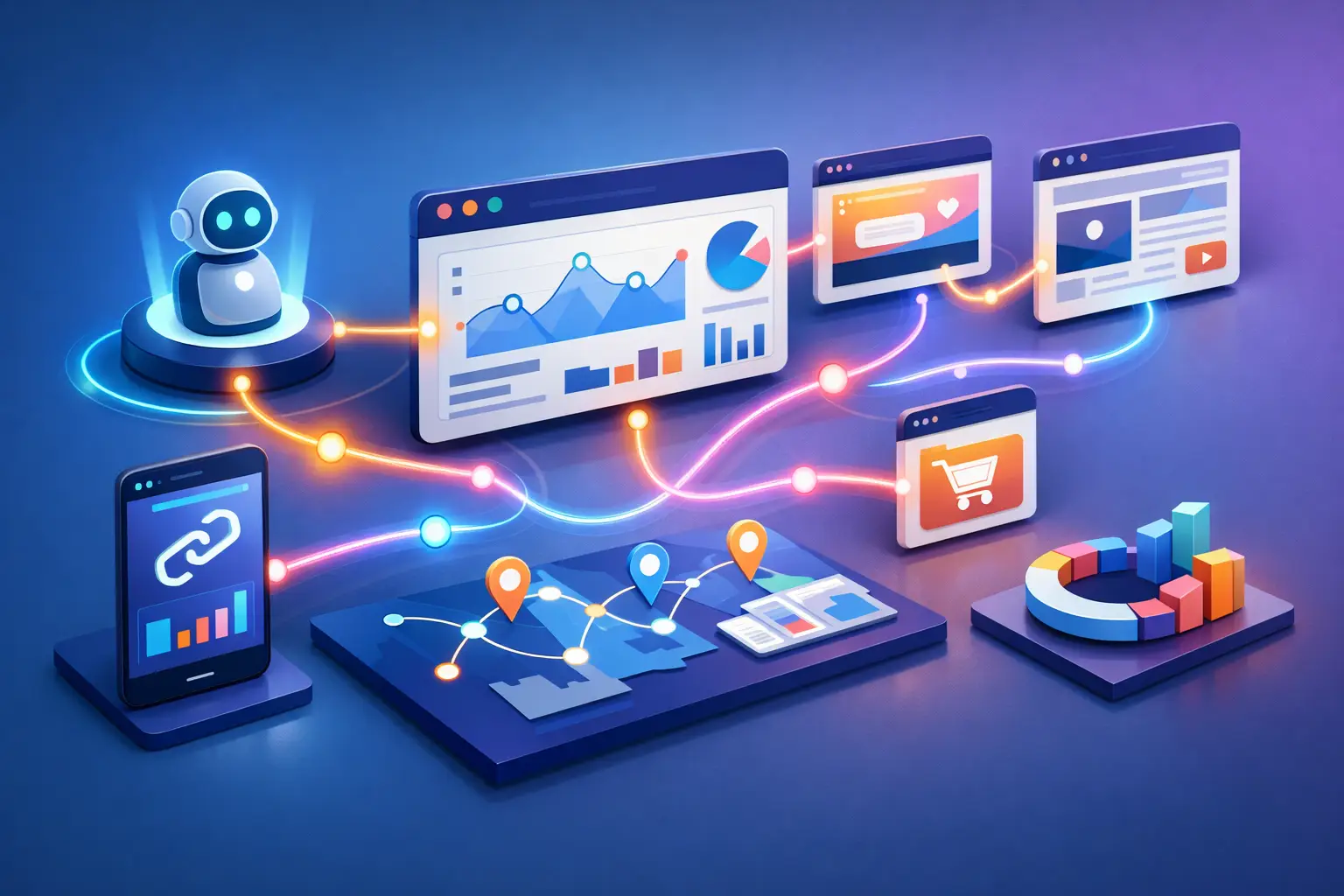
A useful AI agent link example is not just a short link sent to a chatbot. It is a deliberately labeled, trackable link that lets your team separate AI-agent activity from human clicks, previews, scanners, and ordinary referral traffic. That distinction matters when AI assistants, automated research tools, and workflow agents increasingly touch the same content your campaigns depend on.
A generic short link can tell you that something happened. An agent-aware link strategy can help explain what happened, where the request came from, and whether a person likely followed through. For marketers, developers, and growth teams, that means fewer false assumptions in campaign reporting and better decisions about where to invest distribution effort.
What an AI agent link example looks like in practice
Imagine a SaaS team publishing a product comparison page and sharing it through three channels: its newsletter, a creator partnership, and an AI research workflow used by its sales team. Rather than sending every audience to one destination with one catch-all short link, the team creates a distinct branded short link for each source.
The AI workflow link is labeled `AI-Research-Product-Comparison`. Its destination includes campaign parameters that identify the content, distribution purpose, and experiment. The link is also grouped with related campaign assets, so anyone reviewing performance can see it alongside its QR code, social link, and email link.
When traffic arrives, the team does not treat every request as a qualified visit. AgentLink analytics can identify AI-agent traffic patterns separately from normal browser activity, while standard click analytics still show device, geography, referrer, and timing signals where available. The result is a more credible read on performance:
- An agent may retrieve the page repeatedly while building a response or checking updated information.
- A link preview service may fetch the destination once before a human ever sees the message.
- A human may click after an AI assistant surfaces the page as a recommendation.
- A security scanner may inspect the destination before delivery.
These events have different meanings. Counting all of them as identical clicks inflates demand and muddies attribution.
Why AI-agent traffic needs its own view
AI-driven discovery is changing the path between content and conversion. A prospect may ask an assistant for software options, receive a source recommendation, then open the page on a laptop hours later. A sales agent may collect public product information automatically before a rep starts outreach. An internal workflow may validate a resource before adding it to a knowledge base.
None of that fits neatly into the old model of email, social, search, and direct traffic. If you only look at total clicks, you can miss whether a spike reflects human interest, automated retrieval, or a mixture of both.
This is why an AI agent link example should be built around context, not novelty. The goal is not to prove that an AI bot visited a page. The goal is to understand how automated systems interact with your distribution and whether that interaction leads to meaningful downstream action.
For a content marketer, meaningful action could be a human session that reaches a demo page. For a developer team, it might be successful retrieval of documentation without broken redirects. For a creator, it could be identifying which resources assistants surface often enough to deserve an updated version.
Build the link before you distribute it
Start with the destination. Confirm that it is the final page you want an agent or person to reach, not a temporary redirect, staging page, or vague homepage. Deep links are easier to measure and more useful to recipients because they answer a specific question immediately.
Next, create a naming convention your team can actually maintain. A clear format might include the channel, campaign, asset, and month. For example, `AI-Partner-Guide-Sept` tells a teammate more than `newlink17`. Labels do not change public-facing branding, but they make reporting and campaign cleanup far less painful.
Then add campaign parameters consistently. Choose names your analytics team already recognizes and avoid changing terminology mid-campaign. If one link uses `ai_assistant`, another uses `agent`, and a third uses `bot`, reports become harder to compare. Consistency is more valuable than cleverness.
Finally, use a branded domain when possible. People are more likely to trust a short link that clearly belongs to the company sharing it. Trust also matters to automated systems and security tools that evaluate destinations before fetching or displaying them. A transparent trust score at creation time and automatic blocking of malicious destinations reduce the chance that your campaign link becomes a security liability.
Read the data without overclaiming
Agent traffic is a signal, not a guaranteed conversion. A request from an identifiable AI agent can indicate that your material is being retrieved, reviewed, or included in an automated workflow. It does not prove that an assistant recommended your brand, that a person read the content, or that the request resulted in revenue.
Use agent data alongside human engagement signals. Compare the timing of automated requests with browser clicks, page engagement, form submissions, and product activity. If agent retrieval climbs but human follow-through stays flat, your content may be easy to fetch but not compelling enough to earn the next action. If both rise after you publish clearer documentation or a stronger comparison page, you have a more useful hypothesis to test.
Also watch for anomalies. A sudden burst of requests from one source may be legitimate crawling, repeated workflow retries, or unwanted automated behavior. The right response depends on the pattern and your distribution goal. Do not block or dismiss traffic simply because it is automated. First determine whether it helps visibility, creates noise, or puts pressure on a destination that needs attention.
Common mistakes that erase attribution
The most common mistake is reusing one short link everywhere. It feels efficient at launch, but it forces email, social, creator, QR, internal-agent, and partner traffic into one bucket. You may still know the destination performed, but you will not know why.
Another mistake is relying only on a user-agent label. User-agent information can be incomplete, altered, or shared by several types of automated services. Treat it as one input, not a verdict. Good analysis combines request patterns, referrer data, click timing, destination behavior, and campaign context.
Teams also lose value by sending agents to pages built only for conversion. A page overloaded with pop-ups, vague claims, and thin details may not give an automated system enough useful material to retrieve or summarize accurately. The answer is not to write for machines at the expense of people. It is to publish clear, structured, current information that helps both audiences understand the offer.
Make AI-link reporting operational
A strong reporting routine does not need to be complicated. Review agent-related link activity after launches, then compare it with the human outcomes that matter to the campaign. Keep the reporting window long enough to catch delayed visits, especially for B2B content where discovery and action rarely happen in the same session.
Assign ownership, too. Marketing can own campaign naming and destination quality. Developers can validate redirects, APIs, and webhook-driven workflows. Security-minded teammates can review flagged destinations and trust signals. When everyone uses the same link records, the organization spends less time debating whose dashboard is right.
AWSYS brings branded links, campaign controls, safety scanning, and AgentLink analytics into one workflow, so teams can measure automated and human traffic without paying for a pile of disconnected tools. The practical advantage is simple: create links with context, distribute them confidently, and keep the evidence needed to improve the next campaign.
AI agents will not replace every referral channel, and not every automated request deserves attention. But teams that can distinguish machine activity from human intent will make cleaner attribution decisions while others keep calling every fetch a click. Start with one high-value asset, give its agent-facing link a clear purpose, and let the data tell you what deserves a second experiment. #AWSYSCO