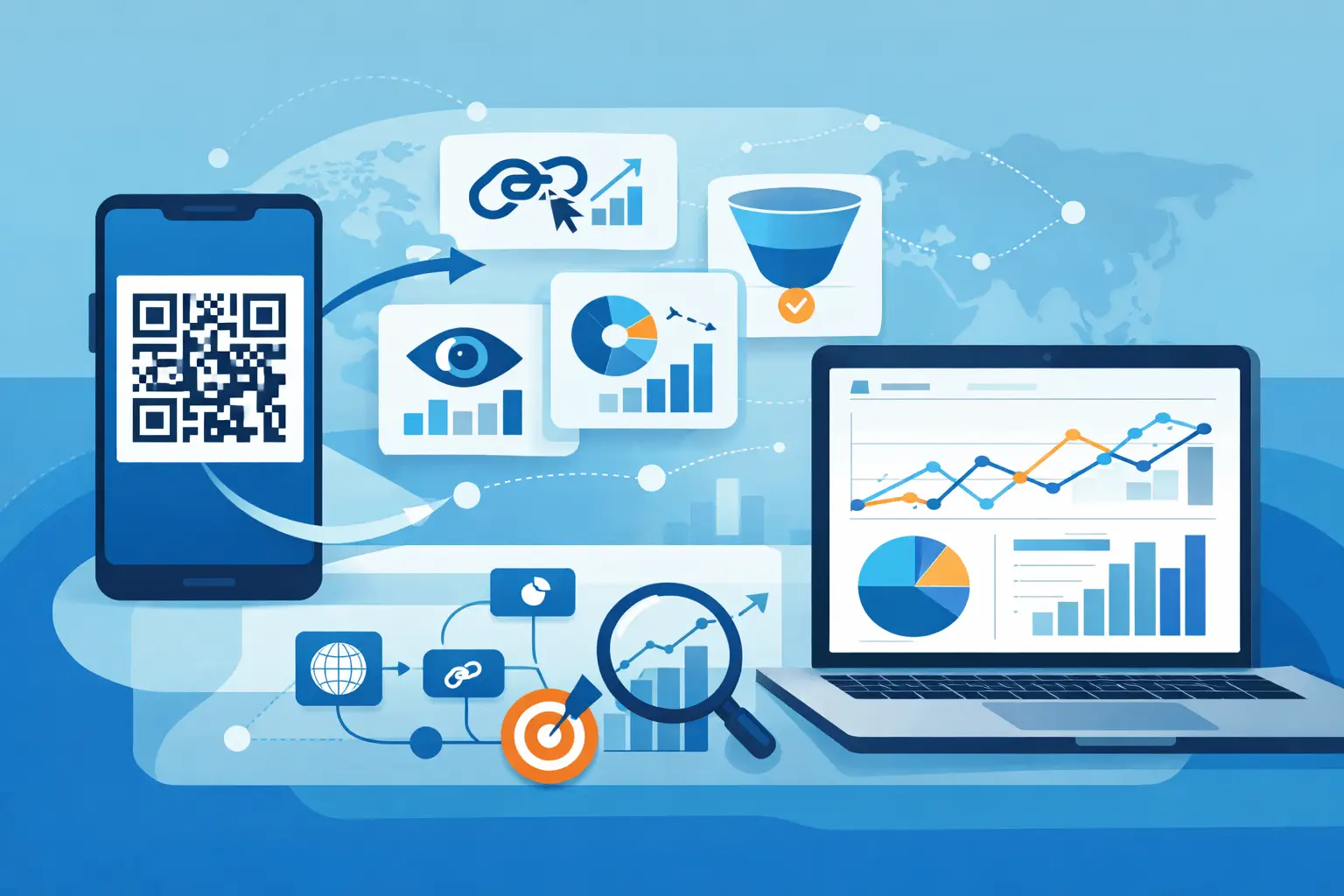
A QR code on a flyer, product package, event sign, or direct-mail piece is only useful if you can answer one question afterward: did it work? QR code campaign tracking turns a black-and-white square into a measurable acquisition channel, showing which physical placements create scans, visits, leads, and revenue.
The mistake is treating every QR code as a shortcut to the same homepage. That gives people somewhere to go, but it gives your team almost nothing to learn. A tracked QR strategy assigns each placement a distinct, branded, measurable path so the next campaign is based on evidence instead of guesswork.
What QR code campaign tracking actually measures
A QR code does not measure a sale by itself. It creates a trackable visit between an offline moment and a digital destination. When someone scans, a dynamic short link can record the scan as a click and pass campaign details to your analytics tools.
That connection lets you evaluate performance at several levels. You can see total scans, unique visitors, repeat visits, device type, operating system, location, referral context where available, and the time a scan occurred. If the destination URL includes campaign parameters, you can also connect that traffic to landing-page engagement, form completions, purchases, app installs, or other downstream actions.
The distinction matters. Scan volume is an attention metric. Conversion rate tells you whether the message, offer, and destination did their jobs. A poster may produce fewer scans than a package insert but generate more qualified leads. Without campaign tracking, those differences disappear into one unlabeled traffic source.
Start with a campaign structure, not a QR design
Before generating anything, decide what you need to compare. Your naming structure should make a report understandable six months from now, even to someone who did not build the campaign.
A simple format might include the campaign, channel, placement, location, and version. For example, a code used on a trade-show booth could be labeled `spring-launch_event_booth_austin_v1`. A code on a counter card at a retail partner might use `spring-launch_retail_countercard_partner-name_v1`.
The goal is not to create the longest label possible. The goal is to separate variables that could change performance. If you use the same QR code across 20 stores, you will know that retail generated interest, but not which store, display position, or call to action earned the scan.
Use a separate QR code whenever one of these variables changes materially:
- The physical location or distribution partner
- The creative, offer, or call to action
- The audience segment or event
- The landing page or intended conversion goal
For smaller campaigns, unique codes for every major placement are usually enough. For high-volume distribution, create a consistent batch structure and organize codes into folders or campaigns from the beginning. Organization is not admin work. It is what keeps reporting usable when your team has hundreds of active links.
Use dynamic QR codes for campaigns that may change
A static QR code permanently encodes a destination. If the URL changes, the printed code is obsolete. A dynamic QR code points to a managed short link, which can redirect visitors to a new destination without requiring a reprint.
That flexibility is practical when inventory, event schedules, landing pages, or offers change. It also protects campaign continuity. A restaurant can update a seasonal menu, a startup can replace an expired promotion, and an event team can redirect post-event scans to a replay or follow-up offer.
Dynamic codes also make QR code campaign tracking possible at the link level. You can retain scan history while improving the destination. Still, change destinations carefully. Redirecting an old conference badge to an unrelated promotion can confuse visitors and distort the campaign record. Keep the visitor promise consistent with the context in which the code was scanned.
Add campaign parameters without making the experience ugly
Your public QR destination should be short, branded, and easy to trust. The tracking detail belongs behind the redirect or inside campaign parameters, not in a long, cluttered URL printed beside the code.
Use a clear parameter convention for source, medium, campaign, and content. A code on a mailer might identify direct mail as the medium, the promotion as the campaign, and the postcard version as the content. A QR code on a display at a specific event can identify the event and booth location.
Consistency beats complexity. If one team labels a source `trade-show`, another uses `event`, and a third uses `conference`, your reports will fragment. Establish a short controlled vocabulary and document it. The same applies to capitalization, separators, date formats, and version names.
A managed link platform such as AWSYS gives teams a practical control layer here: branded short links, QR generation, campaign organization, click analytics, and destination updates in one workflow. That reduces the familiar problem of a QR code created in one tool, parameters built in another, and reporting scattered across several dashboards.
Design for the scan, then test in the real world
The visual code is not decoration. It is a functional interface that has to work under bad lighting, at an angle, through a phone camera, and sometimes from several feet away.
Leave adequate white space around the code, maintain strong contrast, and avoid placing it on busy images. If you add a logo or brand color, protect the code's readability rather than pushing the design to its limits. A beautiful code that will not scan is a failed placement.
Size depends on viewing distance. A QR code on product packaging can be relatively small because the user holds it. A code on a window poster or conference backdrop needs more physical size because scanning happens farther away. Test with multiple phone models before printing a full run.
Also test the complete journey. Scan the final exported artwork, not just the code in your design tool. Confirm that the redirect loads quickly on mobile, the page matches the promise in the call to action, forms are easy to complete, and analytics register the visit. A code can scan perfectly while the campaign still loses people on a slow or irrelevant landing page.
Read the numbers in context
The first report should answer a business question, not merely list click totals. Compare placements against the outcome they were designed to drive. For awareness, scans and unique visitors may be useful. For lead generation, evaluate completed forms and cost per lead. For commerce, focus on purchases, revenue, and conversion rate.
Timing often reveals operational insights. A spike in scans during an event session can indicate that a speaker's call to action worked. Strong evening scans from a storefront may suggest people are engaging after business hours. A code that gets scans but no conversions may have an offer mismatch, a weak mobile page, or an audience that is curious rather than ready to buy.
Be careful with location data and attribution claims. Device location can be approximate, and a person may scan a code in one place but convert later on another device. QR data is strongest when used with landing-page analytics, CRM events, and purchase data rather than treated as a perfect record of every customer journey.
Protect trust at the point of scan
Every scan asks someone to leave the physical world and open a digital destination. That makes trust part of performance. Use a recognizable custom domain, write a specific call to action, and send people to a secure page that matches the printed message.
Avoid vague prompts such as “Scan me.” Tell people what they get: “Scan to view the product guide,” “Scan for event slides,” or “Scan to claim your demo.” Specific language filters out accidental scans and improves the quality of traffic.
Your link workflow should also screen destinations before distribution. A compromised or malicious redirect can damage a campaign faster than weak creative. Automated safety checks and transparent trust signals give teams a chance to catch risk before a code reaches customers, partners, packaging, or public signage.
Turn each campaign into a better next campaign
The value of tracking compounds when you act on it. Keep the placements that generate qualified action, revise the ones that generate curiosity without conversion, and test one meaningful variable at a time. Change the offer, call to action, placement, or landing page, then preserve enough consistency to understand the result.
Do not wait for a massive campaign to build this discipline. Start with two or three distinct QR codes on your next physical asset, give each one a clear purpose, and review the results while the campaign is still active. The next printed square can do more than send traffic. It can tell you where to invest the next dollar. #AWSYSCO