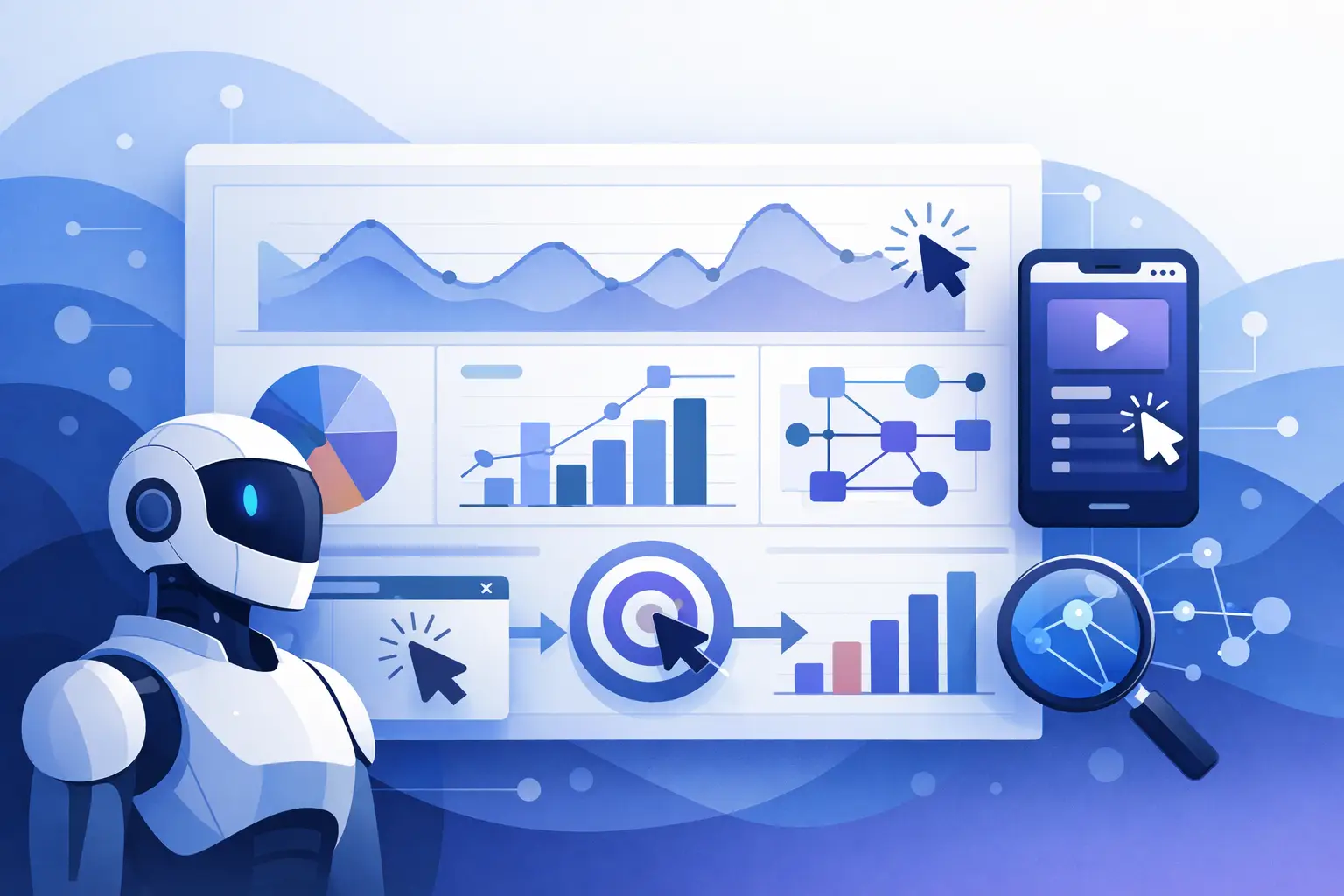
A strange thing is happening in traffic reports: visits are showing up with real engagement signals, but they do not behave like classic human clicks. That is the core story behind we analyzed 'x' ai agent clicks - here's what we found. The short version is simple: AI-driven traffic is no longer edge-case noise. It is becoming a measurable source of discovery, referral activity, and workflow execution, and most teams still are not tracking it cleanly.
For marketers, creators, and developers, this matters because AI agent traffic can look valuable while also breaking your normal attribution logic. A click from an AI-assisted browser session, a summarization tool, or an agent carrying out a task does not always fit the old buckets. If you still group everything into human, crawler, or spam, you miss the signal.
Why "we analyzed x AI agent clicks" matters now
The old analytics model assumed a user saw a link, clicked it, loaded a page, and behaved in mostly predictable ways. That model already had cracks from privacy changes, app browsers, and aggressive prefetching. AI agents widen those cracks.
Some agents fetch links to inspect them. Some request metadata before a person ever sees the page. Some are effectively acting on behalf of a user and can trigger visits that are intentional but not fully human in the traditional sense. Others are low-value noise dressed up as activity. Put all of that in one analytics bucket and your campaign reporting gets blurry fast.
That blur is expensive. It affects routing decisions, lead quality assumptions, content optimization, and how teams judge channel performance. If a campaign appears to be getting traction from a source that is really agent-heavy, you can overestimate demand. If an agent-driven visit is part of a real buying journey, you can underestimate it and cut the wrong channel.
What we looked for in AI agent click behavior
Rather than treat every nonstandard click as suspicious, the smarter approach is classification. The useful question is not, "Is this traffic human or bot?" The useful question is, "What role did this traffic play?"
We looked at AI agent clicks through four lenses: intent signals, timing patterns, technical fingerprints, and downstream behavior. That combination tells a better story than any single metric.
Intent signals are messier than most dashboards admit
A classic bad bot often looks obvious. It hits pages too fast, ignores page structure, and never behaves like a user. AI agent traffic is different. Some requests are machine-led but user-adjacent. They may open a URL because a user asked a tool to summarize a page, verify a source, compare products, or complete a task.
That means a click can be legitimate without being purely human. It can also be worthless without looking obviously malicious. This gray area is exactly why trust scoring and source-aware analytics matter.
Timing patterns tell you more than raw volume
One surprising pattern in AI agent traffic is clustering. Human traffic often follows campaign timing, time zones, and channel habits. Agent traffic can arrive in bursts tied to task execution, content retrieval cycles, or automated assistant behavior.
If you only watch daily totals, these bursts can look like momentum. When you zoom in, the pattern often changes. You may see repeated accesses within narrow windows, odd intervals between requests, or fetch behavior that precedes a human session by minutes or hours. That does not make the click bad. It means the click belongs to a different journey.
Technical fingerprints still matter, but less than teams think
User agents, IP ranges, referrers, and device strings are still useful. They are just not enough on their own. AI-mediated traffic can pass through browsers, proxies, apps, or agent environments that muddy technical identification.
This is where weaker tools fall apart. If your analytics stack only flags obvious crawlers, you get a false sense of clarity. Premium link analytics should help distinguish suspicious automation from meaningful AI-assisted activity, not force you to guess after the fact.
Here is what we found
The biggest finding is that AI agent clicks are not one thing. They fall into at least three practical buckets.
First, there is inspection traffic. This is when an agent checks a destination, reads content, previews metadata, or evaluates a page before a user commits. These clicks matter because they can influence whether the user ever reaches you. They are upstream signals.
Second, there is assistive traffic. This is closer to delegated action. The agent is helping a person compare, fetch, open, or complete a task. These visits may not behave like standard sessions, but they often connect to genuine intent.
Third, there is exploitative or low-value automation. This includes noisy systems, synthetic activity, and unsafe patterns that inflate click numbers without adding business value.
The bad news is that many dashboards treat all three the same. The good news is that once you separate them, performance becomes much easier to read.
AI agent clicks often overstate top-of-funnel performance
If you run campaigns across social, email, creator channels, or product-led flows, AI agent traffic can make early engagement look stronger than it really is. Link-level click counts rise, but landing-page depth, conversion rate, and return visits do not always move with them.
That is not a reason to dismiss the traffic. It is a reason to stop using click totals as a standalone success metric. Clicks have always been an imperfect proxy. With AI agents in the mix, they are even less reliable when viewed alone.
Some AI-driven clicks are high intent, just not high visibility
This was the more encouraging finding. Certain agent-mediated visits correlated with later human action, especially when the destination was clear, trustworthy, and easy to interpret. In plain terms, if an agent could safely inspect a link and understand the page, the user was more likely to continue the journey.
That creates a practical advantage for teams that control destination quality. Strong branding, transparent URLs, trust checks, and clean routing are no longer just cosmetic improvements. They can influence whether AI-assisted workflows pass traffic forward or drop it.
Safety signals matter earlier than most teams realize
Another pattern stood out: unsafe or ambiguous destinations underperform faster in agent-led environments. A human might still click a questionable link out of curiosity. An agent is more likely to screen, reject, or downgrade it.
This raises the bar for link hygiene. If your shortening workflow does not include destination checks and trust visibility before distribution, you are making attribution harder and traffic quality worse at the same time. That is one reason platforms like AWSYS put safety scanning and transparent trust scoring closer to link creation, not as an afterthought.
How teams should measure AI agent traffic differently
The fix is not complicated, but it does require discipline. Start by splitting traffic analysis into click generation, destination access, and downstream conversion. Those are related events, not identical ones.
A raw click should answer, "Something tried to access this link." A destination visit should answer, "Did a meaningful session occur?" A conversion event should answer, "Did this traffic contribute to an outcome?" Once you separate those layers, AI agent traffic stops distorting every report.
You should also watch for source patterns at the link level, not just site-wide aggregates. AI agent behavior tends to vary by campaign type, audience, and destination format. Product links, content links, QR-driven links, and API-triggered links can attract very different traffic mixes.
For developers and technical teams, the real opportunity is instrumentation. If your stack supports API workflows, event tagging, and traffic classification, you can turn AI-agent ambiguity into usable attribution. If it does not, you end up arguing over spreadsheets and inflated click counts.
What this means for marketers, creators, and product teams
Marketers should stop treating every click spike as a win. Look for alignment between click volume, quality signals, and conversion progression. If those do not match, agent traffic may be part of the story.
Creators should care because discovery is changing. More content is being evaluated, summarized, and surfaced through AI-assisted paths before a person visits directly. That makes link trust, metadata quality, and branded presentation more important than many creator stacks account for.
Product and growth teams should care because AI agents are starting to behave like operational users. They open docs, test flows, inspect resources, and support decision-making. That means your links are not just marketing assets anymore. They are interfaces.
The teams that adapt first will not obsess over whether AI agent traffic is good or bad. They will classify it, measure it, and route it intelligently. That is a much better use of time than paying premium rates for shallow reporting.
The useful mindset shift is this: a click is no longer a simple vote of human attention. Sometimes it is a machine checking trust. Sometimes it is a user delegating work. Sometimes it is junk. The job is not to pretend those are the same. The job is to know which is which, then act on it before your reporting, routing, and decisions drift off course. #AWSYSCO